
Vadzo Imaging Validates LI-HDR and eDR on Falcon-830CRH Onsemi HyperLux AR0830 4K HDR Autofocus USB 3.2 Gen 1 Camera
The Falcon-830CRH is an 4K HDR autofocus USB camera with LI-HDR, eDR, VCM autofocus and wake-on-motion for clear
Press Release Disclaimer: This is a press release distributed through the XPR Media network. It has not been independently verified by our newsroom.
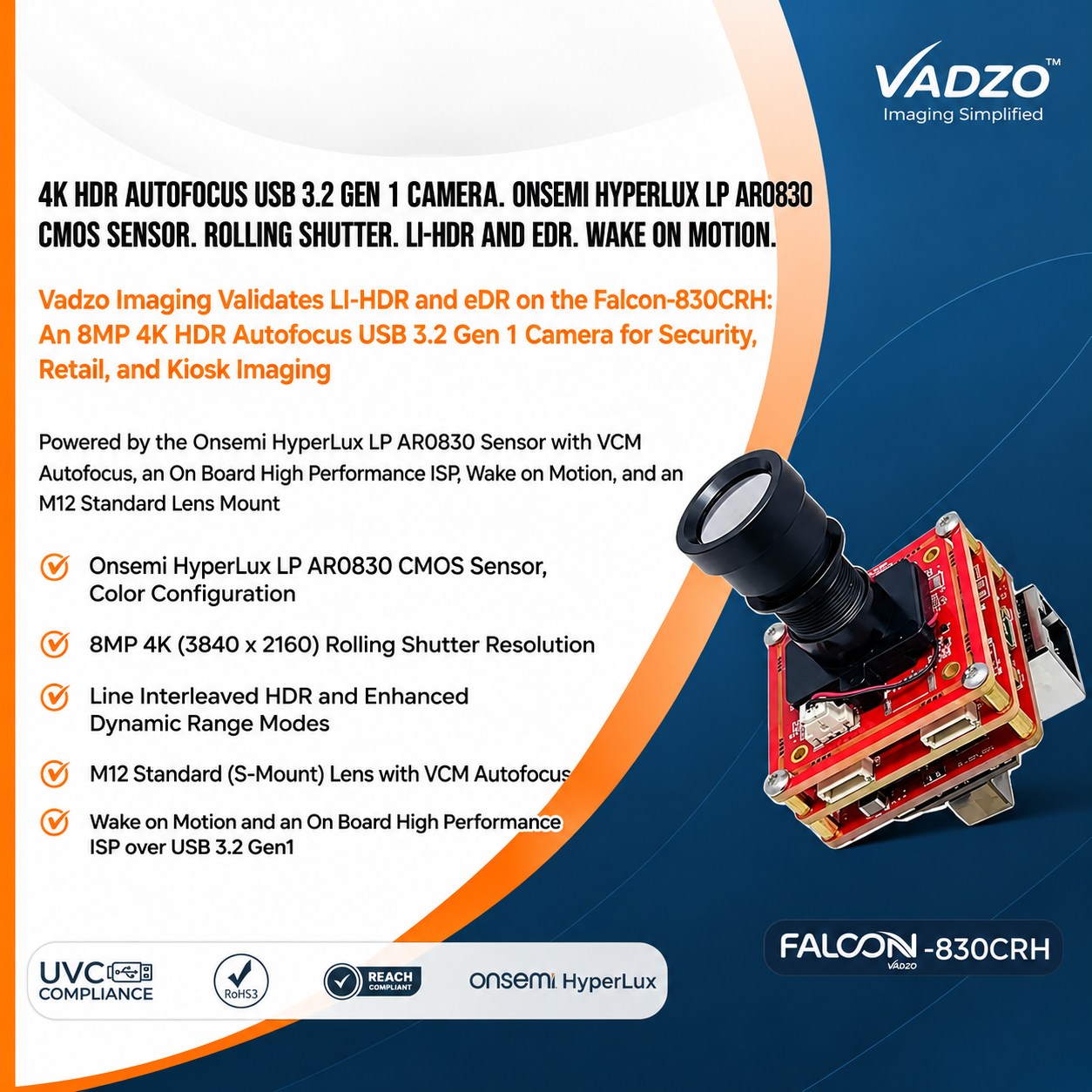

The Falcon-830CRH is an 4K HDR autofocus USB camera with LI-HDR, eDR, VCM autofocus and wake-on-motion for clear security and kiosk imaging in changing light.
FORT WORTH, TX, UNITED STATES, November 2, 2026 /EINPresswire.com/ — Vadzo Imaging, a provider of embedded vision camera products for OEMs and system integrators, today announces validation of LI-HDR and eDR on the Falcon-830CRH, a 4K HDR Autofocus USB 3.2 Gen 1 Camera built on the Onsemi HyperLux LP AR0830 sensor. Part of Vadzo’s USB camera portfolio, the Falcon-830CRH combines VCM autofocus, two dynamic range modes, wake on motion, and an onboard high-performance ISP in a UVC-compliant module.
With this validation, Vadzo presents a 4K LI-HDR eDR Camera for security and surveillance, retail automation, and kiosk and digital signage systems. The camera helps integrators coordinate autofocus, exposure, and wake-on-motion functions for applications involving changing distances, lighting conditions, and activity levels.
Why Autofocus, Auto Exposure, and Wake-Up Matter in a 4K HDR Autofocus USB Camera
A camera monitoring people or activity must maintain focus, manage exposure, and remain ready to capture important events. Autofocus adjusts the lens to keep subjects sharp, while auto exposure adjusts exposure and gain to maintain suitable brightness. When wake on motion is enabled, the camera must also resume operation before capturing the scene.
These functions interact. If the camera wakes, adjusts exposure, and then begins autofocus, the first frames of an event may be captured before the image is fully settled. This can affect applications such as kiosks, retail monitoring, and access-control systems, where capturing the beginning of an interaction matters.
Lighting adds another challenge. Store entrances, windows, and outdoor gates can contain bright and dark areas within the same frame. Standard exposure may lose detail in highlights or shadows, while poor contrast can also affect autofocus performance. High dynamic range modes help retain image information across different brightness levels.
The two HDR modes serve different conditions. Line-interleaved HDR combines different exposure settings within a single frame, helping reduce motion ghosting compared with sequential exposure capture. Enhanced dynamic range (eDR) provides a lighter option for scenes with moderate contrast. Integrators should select the mode based on their actual lighting and motion conditions.
Subject distance also changes in real installations. People approach kiosks, shoppers move along shelves, and visitors stand at different distances from access points. VCM autofocus helps the camera adjust to these changes, but its performance should be evaluated with the selected lens and HDR mode active.
Testing the complete sequence at the intended installation site helps identify focus delays, exposure changes, and false motion triggers before large-scale deployment.
How the Falcon-830CRH Coordinates Autofocus, HDR, and Wake on Motion
The Falcon-830CRH is built on the Onsemi HyperLux LP AR0830, an 8MP color rolling shutter sensor with 4K resolution (3840 × 2160). The sensor supports line-interleaved HDR, enhanced dynamic range, super-low-power operation, and wake on motion. Its line-interleaved HDR mode can extend dynamic range up to 140dB.
The module adds an M12 standard (S-Mount) lens with VCM autofocus. A voice coil motor moves the lens electronically, allowing focus to adjust to subjects at different distances without manual intervention. Vadzo has validated both LI-HDR and eDR modes on the module. Its 4K resolution also provides room to crop selected image regions while retaining useful detail.
Choosing Between LI-HDR and eDR
Line-interleaved HDR alternates exposure settings across rows within a single frame and combines them to capture bright and dark regions. Since the exposures are captured within the same frame, moving subjects are less likely to show the ghosting associated with sequential exposure techniques. The trade-off is a small reduction in vertical detail.
Enhanced dynamic range, or eDR, is intended for scenes with moderate contrast, such as indoor environments with some window light. It provides an alternative when the full LI-HDR mode is not required.
Integrators should compare both modes using their actual scenes. Testing a person approaching a camera in different lighting conditions can help determine how each mode affects image quality and autofocus behavior.
Onboard ISP and Wake-on-Motion Operation
The onboard high-performance image signal processor converts raw sensor data into a finished color image. It also supports automatic exposure and automatic white balance, allowing the host to receive processed frames.
Wake on motion allows the module to operate in a very low-power state and resume capture when activity is detected. After waking, the sensor must resume operation, exposure must converge, and autofocus must settle. The time required depends on the host, scene, lens, and camera configuration.
Integrators can improve response by selecting a suitable starting focus position, keeping exposure settings appropriate for the environment, and adjusting motion thresholds to avoid unnecessary wake events caused by shadows or changing light.
USB 3.2 Gen1 and Lens Integration
The module connects through USB 3.2 Gen1 and supports UVC compatibility, allowing Windows and Linux hosts to access the camera without a proprietary driver. A single USB connection carries data and power.
The M12 standard lens mount provides flexibility in selecting optics for kiosks, store entrances, and access-control installations. Integrators should confirm the lens field of view, focus range, cable length, operating temperature, and power requirements against their installation conditions. Active USB extensions may be required for longer cable runs.
Product Overview
The Falcon-830CRH is an 8MP color USB module built on the Onsemi HyperLux LP AR0830 sensor and validated for LI-HDR and eDR. As an 8MP VCM Autofocus USB Camera, it focuses automatically on subjects at different distances, and as a 4K Wake-on-Motion USB Camera, it rests between events and resumes capture when the scene changes. The AR0830 Super Low Power USB Camera designation reflects the sensor’s super low power mode, and the 4K AE AWB USB Camera designation covers automatic exposure and white balance inside the ISP. The module combines the sensor, the ISP, and a USB 3.2 Gen1 controller with an M12 standard lens and VCM autofocus. It also serves as an 8MP LI-HDR USB 3.2 Gen 1 Camera, an AR0830 eDR USB 3.2 Gen 1 Camera, and a 4K Line Interleaved HDR USB Camera,
Key specs: 8MP 4K (3840 x 2160) Max Resolution | Onsemi HyperLux LP AR0830 Sensor | Color with Rolling Shutter | USB 3.2 Gen1 Interface | M12 Standard (S-Mount) Optics with VCM Autofocus and an 8MP Enhanced Dynamic Range USB Camera for designs that need a standard interface.
M12 Lens with VCM Autofocus
The module uses an M12 standard lens holder with voice coil motor autofocus. The M12 format supports a range of lens options, while the VCM actuator electronically adjusts focus without manual intervention.
This is useful when people or objects appear at different distances from a kiosk, shelf, or entrance camera. Integrators should evaluate focus speed and repeatability at the closest and farthest working distances expected in the application. Testing with a focus chart or representative subject can help confirm the lens configuration.
Line-Interleaved HDR for High-Contrast Scenes
LI-HDR combines different exposure settings within a single frame to retain details in bright and dark regions. It is suited to scenes such as sunlit entrances, kiosks beside windows, and gates exposed to changing daylight.
Vadzo has validated LI-HDR on the Falcon-830CRH. Integrators should test the mode under their actual lighting conditions and assess the balance between dynamic range, image detail, and autofocus performance.
Enhanced Dynamic Range for Moderate-Contrast Scenes
Enhanced dynamic range (eDR) is a lighter dynamic range mode for environments with moderate contrast, such as indoor spaces containing some window light. It provides an alternative when the full LI-HDR mode is unnecessary.
Teams can compare eDR and LI-HDR during evaluation and select the appropriate configuration for each camera position. This allows different installation environments to use the mode best suited to their lighting conditions.
Wake on Motion for Low-Power Camera Operation
Wake on motion allows the camera to remain in a low-power state between activity and resume capture when movement is detected. This can help reduce energy consumption and heat in suitable installations.
The time from motion detection to a usable image depends on sensor startup, exposure convergence, autofocus, and host behavior. Integrators should measure the complete wake sequence and tune the motion threshold at the actual site to reduce false triggers from shadows and passing lights.
Onboard ISP with Auto Exposure and Auto White Balance
The onboard ISP processes raw sensor data into a finished color image and supports automatic exposure and automatic white balance. This reduces the image-processing work required from the host and helps maintain consistent output as lighting changes.
The module functions as an AR0830 Auto White Balance USB Camera and a 4K Auto Exposure USB Camera. Manual settings are also available for applications requiring controlled image parameters.
USB 3.2 Gen1 and UVC Compatibility
USB 3.2 Gen1 connectivity and UVC compatibility simplify integration with Windows and Linux systems. The standard USB interface reduces the need for proprietary camera drivers, while the M12 lens mount gives OEMs flexibility when selecting optics.
Vadzo supports OEM programs with lens matching, firmware customization, and enclosure design. Teams can use the same module and documentation from initial evaluation through pilot deployment and production.
“Customers at kiosks, stores, and gates want the camera to be ready, sharp, and correctly exposed from the first frame. The Falcon-830CRH was validated with that in mind. Autofocus follows people at different distances, LI-HDR and eDR help manage challenging lighting, and wake on motion lets the camera rest between events. We are also clear about how these features interact. After a wake, exposure and focus need time to settle, so we encourage teams to measure the complete sequence on their own hardware. Testing at the actual installation position, in both bright and dim conditions, provides valuable insight before volume production.”
— Alwin Vincent, Product Manager, Vadzo Imaging
Applications of the 4K HDR Autofocus USB Camera
Security Monitoring in High-Contrast Lighting
Entrances, gates, and perimeter locations often combine bright backgrounds, dark interiors, and subjects at changing distances. The Falcon-830CRH can serve as a Smart Security USB Camera or Security Surveillance USB Camera, using autofocus and HDR modes to support image capture under changing conditions.
Wake on motion can help reduce power consumption between events. Installers should tune motion thresholds to avoid false triggers from shadows and changing light. Lens selection should also account for the typical subject distance and camera position.
Retail Monitoring with Autofocus and Dynamic Range Control
Retail environments combine window glare, illuminated displays, and shoppers moving between different distances. The camera’s autofocus helps maintain sharp images, while eDR and LI-HDR provide options for managing different lighting conditions.
As a Retail Store USB Camera, the Falcon-830CRH can support shelf monitoring, counter imaging, and retail automation systems. Automatic exposure and white balance also help maintain consistent image output as store lighting changes.
Kiosk Imaging for Face and Document Capture
Kiosk users approach, lean in, and present documents or mobile devices at different distances. VCM autofocus helps maintain focus as the subject position changes, while HDR modes support installations with bright windows or entrances behind the user.
The camera can function as a Kiosk USB Camera, combining 4K resolution, autofocus, and a standard USB connection. Its M12 lens mount also supports different optical configurations for kiosk enclosures.
Frequently Asked Questions
Q: Does HDR slow down autofocus?
A: Vadzo Imaging explains that autofocus relies on a measure of sharpness taken from the image, and HDR changes how that image is built. In some modes, the combined frame is a little different from a normal one, so focus speed can change. The effect depends on the mode, the lens, and the scene. Vadzo Imaging recommends testing focus speed with the chosen HDR mode active, at the real working distances, with real subjects, since the result depends on the lens and the scene. A 4K AE AWB USB Camera that settles exposure quickly also gives the focus system a steadier image to work with.
Q: How can a camera focus quickly after waking on motion?
A: After a wake, the sensor must resume, exposure must converge, and focus must settle, and a Smart Security USB Camera that rests between events has to repeat that chain every time. Teams can shorten the sequence by starting from a sensible focus position, such as the usual standing distance, and by using an HDR mode that tolerates imperfect exposure in the first frames. Tuning the motion threshold keeps the camera from waking for shadows. Vadzo Imaging suggests measuring the whole chain on the real host, since it depends on the host as well as the camera, and a short trial usually gives a clear answer.
Q: When should a kiosk use LI-HDR instead of eDR?
A: Use line interleaved HDR when the scene has extreme contrast, such as a kiosk facing a bright window or a sunlit entrance behind the user. It interleaves exposures within one frame, which avoids ghosting on moving people, and it costs a little vertical detail. Use enhanced dynamic range for moderate contrast, such as an interior with some window light. A 4K LI-HDR eDR Camera lets teams switch in software, and Vadzo Imaging recommends recording the real scene in each mode, since the best choice depends on the site.
Q: Why does a kiosk or store camera need autofocus if customers stand in one place?
A: People rarely remain at exactly the same distance from a camera. They approach, step back, lean forward, or hold documents and phones at different positions. An 8MP VCM Autofocus USB Camera adjusts focus to help maintain sharp images across these distances. Integrators should test focus speed and range before finalizing the enclosure and lens design.
Q: Why should integrators choose Vadzo Imaging as their 8MP USB 3.2 Gen 1 Camera Manufacturer?
A: Vadzo Imaging offers more than a camera module built around a capable sensor. Integrators working with Vadzo Imaging receive a module validated for LI-HDR and eDR, with voice coil autofocus, wake on motion, and an on-board high-performance ISP, along with candid guidance on how focus, exposure, and wake behave together, plus engineering support for lens selection, firmware customization, and enclosure design. Vadzo Imaging maintains evaluation kits with no minimum order requirement, so teams can test on their own hardware before committing to volume production.
Availability
The Falcon-830CRH 4K HDR Autofocus USB 3.2 Gen 1 Camera, built on the Onsemi HyperLux LP AR0830 sensor, is available for evaluation and production orders. Evaluation kits include the camera module, an M12 lens, a USB 3.2 Gen1 cable, and platform documentation, with no minimum order requirement. Teams can evaluate autofocus speed with both HDR modes, measure the time from wake to a usable frame, and tune motion thresholds under their actual operating conditions. Integrators requiring a different lens or configuration can contact Vadzo to discuss their requirements.
About Vadzo Imaging
Vadzo Imaging is a global provider of embedded vision solutions, offering camera technologies and imaging platforms for robotics, industrial automation, UAVs, edge AI, and medical systems. Its products are designed for integration with leading embedded platforms. Vadzo supports customers through hardware customization, firmware development, and module-level drivers, enabling faster development and deployment vision-based systems across USB, MIPI, GigE, Wi-Fi, and SerDes camera interfaces.
Alwin Vincent
Vadzo Imaging
+1 817-678-2139
alwin@vadzoimaging.com
Visit us on social media:
LinkedIn
YouTube
X
Legal Disclaimer:
EIN Presswire provides this news content “as is” without warranty of any kind. We do not accept any responsibility or liability
for the accuracy, content, images, videos, licenses, completeness, legality, or reliability of the information contained in this
article. If you have any complaints or copyright issues related to this article, kindly contact the author above.

Media gallery

